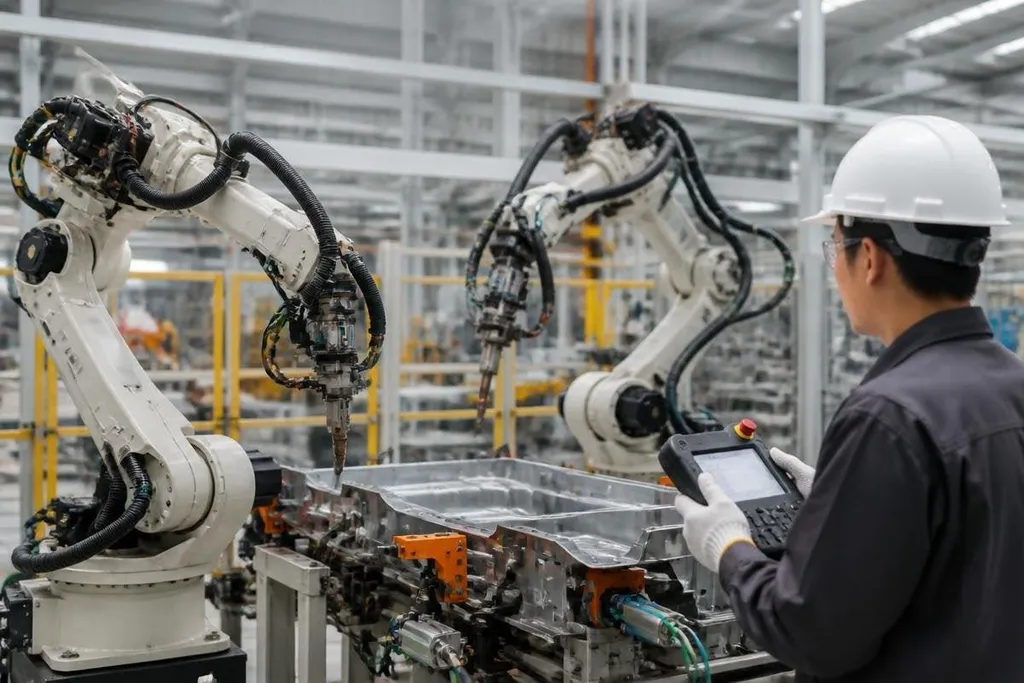
Robots become useful when a factory can buy one, install it, and keep it running. Asia’s robotics growth rests on that full chain, from motors and sensors to the companies that need automation every day.
- Factory demand gives robot makers a place to test paid work.
- Local suppliers can shorten the path from a design to a working machine.
- The open test is whether more robots leave pilot sites and enter daily operations.
Demand starts on the factory floor
Manufacturers adopt robots when a task repeats often enough to justify the cost. Machine tending, welding, inspection, packing, and movement between workstations all fit that pattern because the work has clear steps and measurable results.
That demand gives robot makers useful feedback. A factory can show where a gripper slips, where a camera loses an object, or where a robot stops during a shift. Each fault points to a change in hardware or software.
The buyer also sets a hard test. A robot needs to handle the required payload, reach the work area, and run for the planned shift. A smooth demonstration has little value if the machine cannot repeat the task beside a real production line.
Parts matter as much as robot arms
Robot arms are one part of a larger machine.
Their motion depends on motors, gearboxes, controllers, cables, cameras, safety sensors, and software. If those parts arrive from nearby suppliers, a maker can test changes faster and repair machines with fewer delays.
The same logic applies to mobile robots. A warehouse vehicle needs wheels or drive modules, batteries, sensors, wireless links, and software that maps its route. A weak part can stop the whole system, even when the robot’s control software works as planned.
This is why a robotics region needs more than one successful company. It needs suppliers that can make parts, integrators that can install systems, and service teams that can fix them after delivery.
Research has to meet paid work
Universities and public labs can help with robot control, vision, grasping, and movement. Those systems still need work outside a lab. Floors change, parts arrive in different positions, people cross the robot’s path, and lighting can shift during a day.
A useful path from research to industry has clear handoffs. A lab produces a method. A company turns it into software or hardware. An integrator connects it to a production line. The customer then measures missed picks, stopped hours, maintenance calls, and output.
The evidence trail also needs dated reporting on the companies and systems involved. Robot24.com robotics reporting can connect a research claim to a named machine, deployment site, and order record, giving you facts to compare with Asia’s shipped systems and repeat purchases.
I’d judge Asia’s position by shipped systems and repeat orders, not lab videos.
The limits behind the growth
Asia’s robotics market still faces hard limits. Many tasks are too varied for fixed automation, and small factories may lack staff who can program or repair a robot. A machine that needs a specialist for every adjustment can cost more to run than its purchase price suggests.
Safety adds another test. A robot working near people needs sensors, speed limits, guarded zones, and a clear stop procedure. Mobile systems also need to handle blocked routes and changes in floor space without creating a risk for workers.
The business case can fail for less technical reasons, too. A factory may change its product line before the robot pays for itself. A supplier may stop supporting an older controller. A gripper may wear faster than the sales plan allowed.
A practical check for buyers
Use these questions before treating regional growth as proof that a robot will fit your site:
- Name the task: Can the maker describe the exact work, object size, cycle time, and payload?
- Check the site: Has the system run in a factory with similar floors, lighting, people, and product changes?
- Count stopped time: How often does the robot need a person to clear a fault or restart a task?
- Price the whole system: Include tooling, safety hardware, installation, training, service, and spare parts.
- Check support: Who repairs the robot, and how long will parts and software updates remain available?
Asia’s robotics growth makes sense where factories, suppliers, researchers, and service teams work on the same paid task. The next test is simple: how many systems can run for a full year after the launch video is gone?